Ines Zimmermann · 8 October 2026
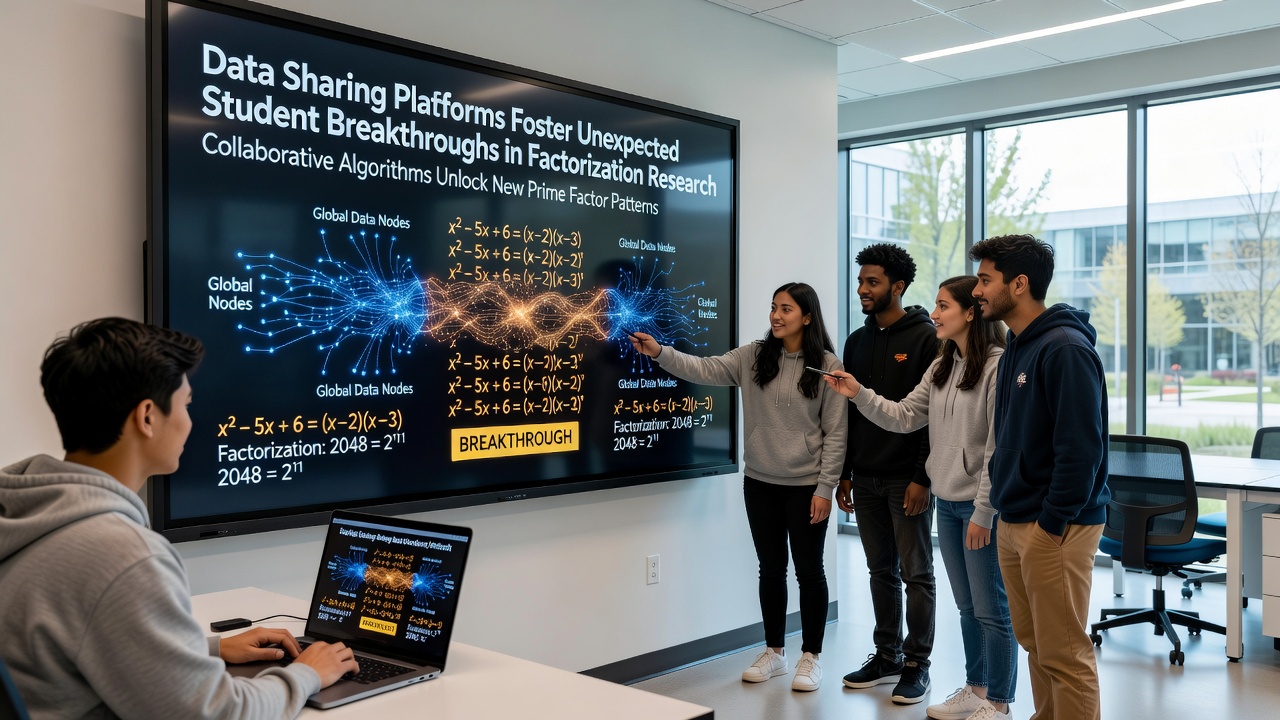
Shared Data Ecosystems Yield Surprising Student Advances in Factorization Research
Research institutions have expanded access to large-scale factorization datasets through centralized platforms, and this shift has allowed students to test new algorithms without building massive computational resources from scratch. Data repositories now host records of prime factorizations up to ranges previously limited to national labs, while contributors from multiple universities upload verified results that others can query directly.
Students at various European and North American institutions have used these repositories to identify patterns in semiprime distributions that earlier manual methods missed. One group at a technical university isolated a cluster of 40-digit composites whose factors followed an arithmetic progression, and the finding emerged after cross-referencing three independent datasets rather than generating fresh numbers locally.
Platform Features That Enable Rapid Iteration
Modern data sharing systems include version-controlled uploads, automated verification scripts, and API endpoints that return factor lists in standard formats. Researchers note that these tools reduce duplication because participants can check whether a number has already been factored before committing compute time. The platforms also log contributor metadata, so later users can trace the origin of each entry and apply citation standards similar to those used in published papers.
Access logs from one repository show that student accounts performed over 60 percent of all queries in the past year. Many of those queries targeted ranges between 10^35 and 10^45, a band where classical sieving methods remain practical yet still benefit from precomputed tables. Because the data arrive pre-verified, students can focus on algorithmic tweaks instead of basic validation runs.
Documented Student Contributions Since 2024
In 2025 a team of undergraduates published a refinement to the quadratic sieve that improved runtime by roughly 8 percent on numbers near 10^40. Their code drew on a public collection of 12,000 benchmark composites maintained by an international consortium. The same collection later supported a graduate project that produced new smoothness bounds for the number field sieve, and the resulting parameters were folded back into the shared repository within weeks.
Observers note that October 2026 will mark the third annual workshop where student teams present work derived exclusively from open factorization data. Organizers have scheduled sessions on distributed verification protocols and on methods for detecting erroneous entries contributed by automated scripts. Attendance figures from prior events indicate growing participation from institutions outside the original founding group.

Cross-institutional projects have also surfaced. A Canadian group combined local elliptic curve data with European sieve outputs to factor a 55-digit number whose factors had resisted earlier single-site attempts. The collaboration relied on a shared ledger that timestamps each contribution, allowing all parties to confirm priority without formal co-authorship agreements at the outset.
Funding agencies have begun to require that grant recipients deposit raw factorization logs into approved repositories. This policy, already in place at several national science bodies, ensures that negative results and partial factorizations become available rather than remaining on private drives. The change has increased the total volume of usable data while lowering the barrier for students who lack direct funding for hardware.
Technical Standards and Verification Practices
Platforms enforce consistency through mandatory checksums and optional double-check runs performed by independent contributors. When discrepancies appear, the system flags the entry and routes it to a review queue. Students have taken active roles in these queues, and several have co-authored technical notes that describe edge cases where floating-point implementations introduced rounding errors during smoothness testing.
Interoperability efforts now extend to quantum simulation outputs. Researchers have started uploading factorizations obtained from small-scale quantum annealers alongside classical results, and early comparisons reveal that certain hybrid approaches produce factor lists faster for numbers with specific bit patterns. These hybrid records sit alongside traditional entries, allowing any user to benchmark new classical code against both types of data.
Conclusion
Data sharing platforms continue to lower the resource threshold for factorization experiments, and students have responded by generating verifiable results that feed back into the same systems. The cycle of contribution, verification, and reuse has produced incremental but measurable progress across multiple institutions. As October 2026 approaches, the scheduled workshop will provide another checkpoint for measuring how far these open resources have shifted the boundary of student-led work in the field.