
Harper Griffin · 24 September 2026
Student Publications Harness Open Resources to Reimagine Number Theory Research
Student-led publications have begun integrating open resources into longstanding number theory investigations, and this shift connects university groups across multiple continents while they share datasets, proofs, and computational tools in real time. Research teams at smaller institutions now access the same repositories once limited to major centers, which allows them to test conjectures that previously required expensive software licenses or restricted archives. Data from the National Science Foundation shows increased submissions from undergraduate and graduate collectives in the past three years, and these contributions often focus on refining algorithms for Diophantine equations alongside modular forms.
Expansion of Student Journals Through Shared Platforms
Platforms built on open-source frameworks have lowered barriers for student editors who manage peer review cycles without traditional publishing overhead, and this model supports rapid iteration on partial results that once stayed hidden in private notes. Observers note that journals originating from student networks frequently publish supplementary code alongside formal arguments, which enables others to verify calculations or extend them within days rather than months. In September 2026 several of these outlets plan to host a coordinated release of preprints addressing refinements to the abc conjecture, while participants coordinate through public repositories that track version histories and contributor credits automatically.
Technical Approaches Emerging from Collaborative Workflows
Groups combine symbolic computation libraries with cloud-based notebooks to explore prime gaps and elliptic curve ranks, and the resulting workflows reduce duplication of effort across sites. Researchers at one European university recently adapted an open dataset originally compiled for cryptographic benchmarks, then applied it to questions about the distribution of smooth numbers, while a parallel team in North America contributed statistical visualizations generated from the same files. Studies indicate that such reuse patterns accelerate the identification of edge cases that single-author papers might overlook, yet the process still requires careful attribution to maintain academic standards.
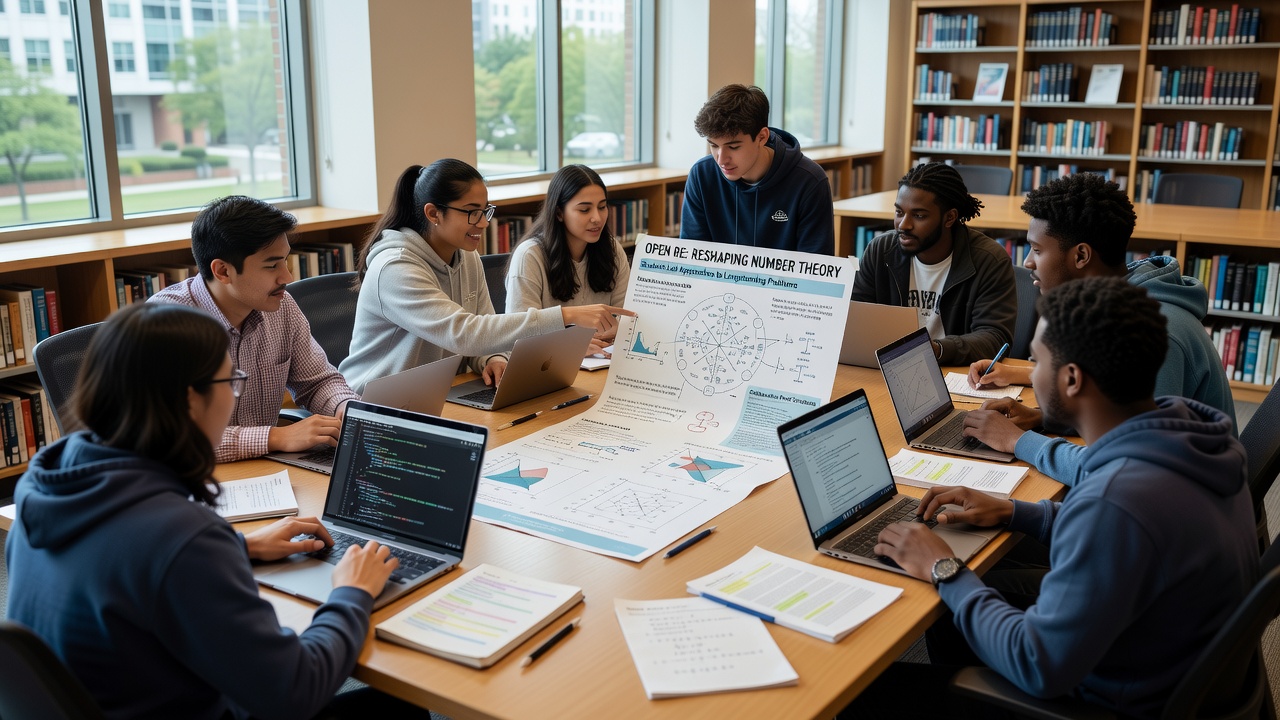
Geographic Spread and Institutional Partnerships
Participation has widened beyond initial clusters in North America and Western Europe, with new nodes appearing in East Asia and Latin America that contribute translations of key lemmas into local languages alongside original findings. According to reports from the European Research Council, funding calls now explicitly list open-resource student publications as eligible dissemination channels, which encourages cross-border teams to apply for small grants covering server costs or workshop travel. One Australian mathematics department documented how its undergraduates used publicly available proof assistants to verify results on Waring's problem before submitting them to an international student journal, and similar practices have appeared in Canadian programs focused on analytic number theory.
Challenges in Maintaining Rigor and Attribution
Editors balance speed with verification by requiring contributors to deposit raw computation logs in addition to polished manuscripts, and automated checks flag inconsistencies before human review begins. Those who manage these outlets report that disputes over priority occur less often when timestamps on shared repositories provide clear records, although occasional disagreements still arise around the interpretation of joint data. Training sessions organized by senior faculty help new student editors recognize when a result qualifies as novel versus an incremental improvement already covered in existing literature.
Conclusion
Student publications continue to integrate open resources into number theory workflows, and the pattern shows measurable growth in both submission volume and geographic reach through 2026. Institutions that support these efforts gain visibility for their trainees while contributing to a broader pool of verified techniques available for future problems. The combination of accessible archives, shared code, and structured review processes creates pathways that earlier generations lacked, and ongoing developments will likely determine how widely these models extend into other mathematical domains.